Nicotine withdrawal: symptoms, duration and timeline
Narrated by an AI voice
You've quit smoking and suddenly you're more irritable than usual, sleeping badly or finding it hard to concentrate? Especially in the first few days, quitting can feel surprisingly hard. At first that seems contradictory: you've stopped something that was harming your health. And now, of all times, you feel worse.
Often, nicotine withdrawal is behind this. Your nervous system has got used to a regular supply of nicotine and has to readjust after you quit. Physical and psychological symptoms can come up along the way.1 How strong they are varies from person to person. Some people experience several withdrawal symptoms at once, others only a few or hardly any.23
What happens during nicotine withdrawal
When you smoke, nicotine passes through your lungs into your blood and reaches your brain within a few seconds. With regular use, your nervous system adapts to the recurring supply of nicotine. When this supply suddenly stops after you quit, the system has to readjust once again.13
Your nicotine level doesn't only drop after you quit, it already drops between cigarettes. At that point, the first withdrawal symptoms, such as restlessness, irritability or difficulty concentrating, can already appear. Smoking again brings nicotine back to the brain, and the symptoms ease off for a while. This creates a cycle that makes quitting so hard.14
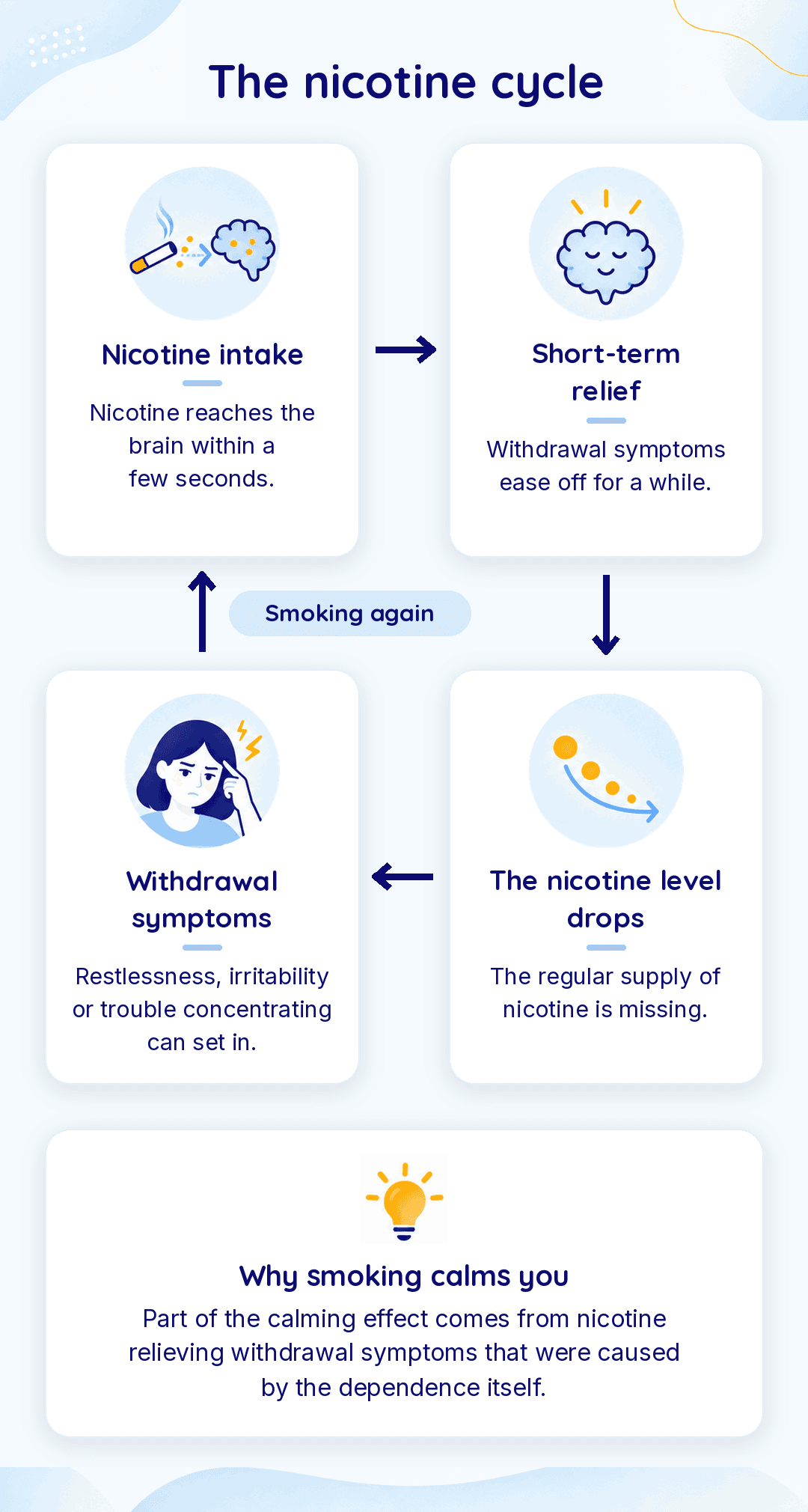
That's why smoking often feels as if it calms you down or improves your concentration. But part of this effect is that the cigarette relieves withdrawal symptoms that the dependence created in the first place.15 After you quit, this short-term relief disappears. Your nervous system needs some time to readjust to everyday life without a regular supply of nicotine.1
Which withdrawal symptoms can occur
- Strong cravings: This means the urge to smoke. It can show up as a pressing impulse or a recurring thought.
- Irritability and inner restlessness: You're more sensitive, get annoyed more quickly or feel tense.
- Difficulty concentrating: Tasks take more effort and you get distracted more easily.
- Sleep problems: You find it harder to fall asleep, sleep more restlessly or wake up more often.
- Low mood: You feel down, frustrated or more anxious than usual.
- Increased appetite: You feel hungry more often or want to eat more.
This list shows what can occur, not what has to occur. How strongly you feel withdrawal depends, among other things, on how strong your dependence is.2
When does withdrawal start and when is it at its worst?
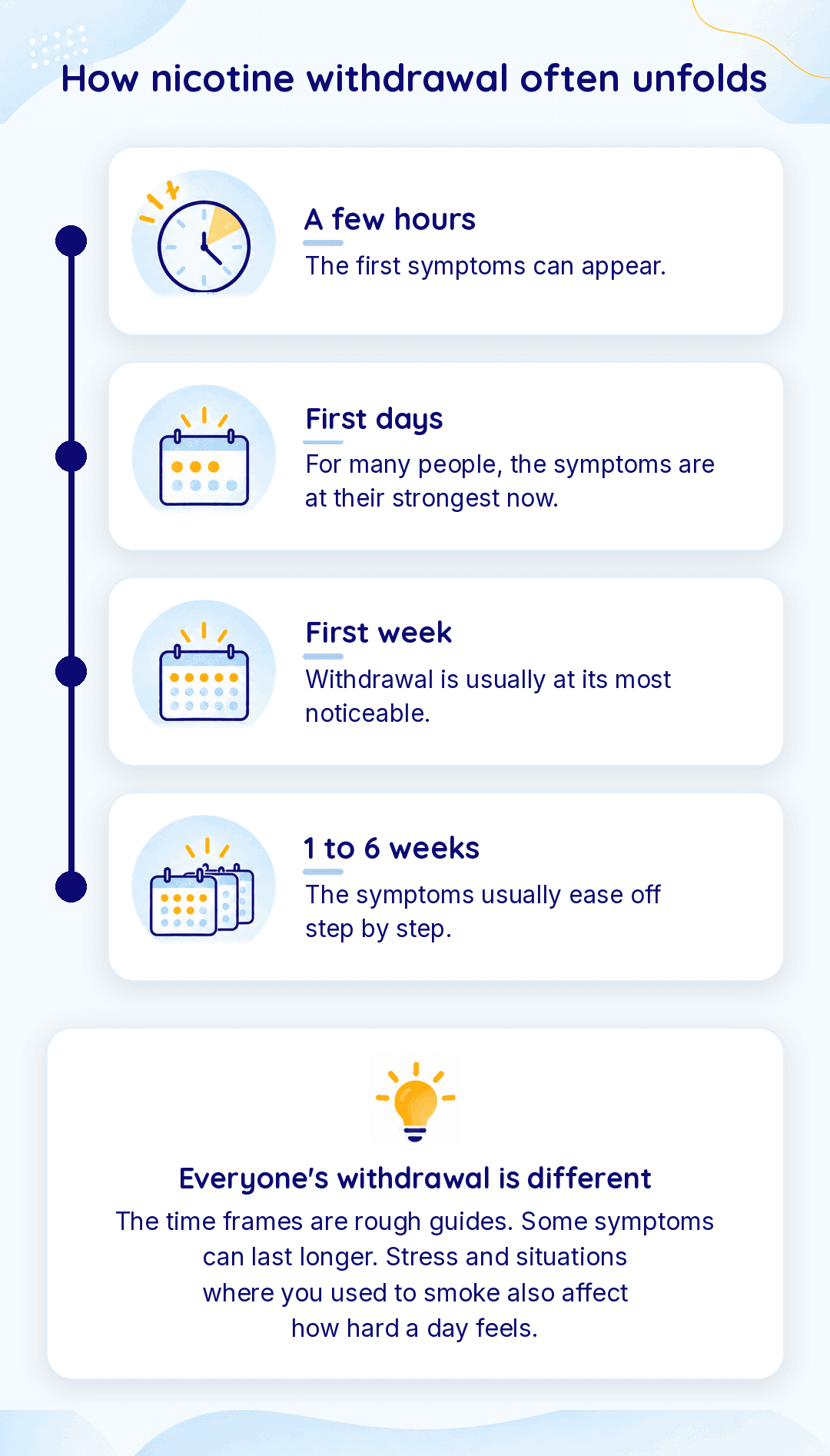
The first withdrawal symptoms can appear just a few hours after your last nicotine intake.1 For many people they are strongest in the first few days, and overall, withdrawal is usually most noticeable in the first week.748
After that, the symptoms usually ease off step by step.4 All in all, withdrawal symptoms usually last one to six weeks.2 Some symptoms can, however, last longer, sometimes even a few months.28
These figures are not an exact prediction for your own quit attempt. Maybe the third day feels surprisingly easy and the fifth gets harder. Besides physical withdrawal, stress and situations in which you often used to smoke also affect how hard a particular day feels.1
More important than the question of which day will be the worst is the direction: physical withdrawal is strongest at the beginning and then eases off over the following weeks, even if there are harder days in between.2
Why cravings can still come up later
The urge to smoke, also called craving, doesn't always have the same cause. In the first few days, your body is missing nicotine, and that can trigger the urge. But it can also come up long after your body has readjusted, sometimes even years later.214
In that case, learned habits are behind it. For years, smoking may have been linked with your morning coffee, your break at work, driving, alcohol, certain people or stress. When you find yourself in one of these situations again later, it can still trigger the urge to smoke.19
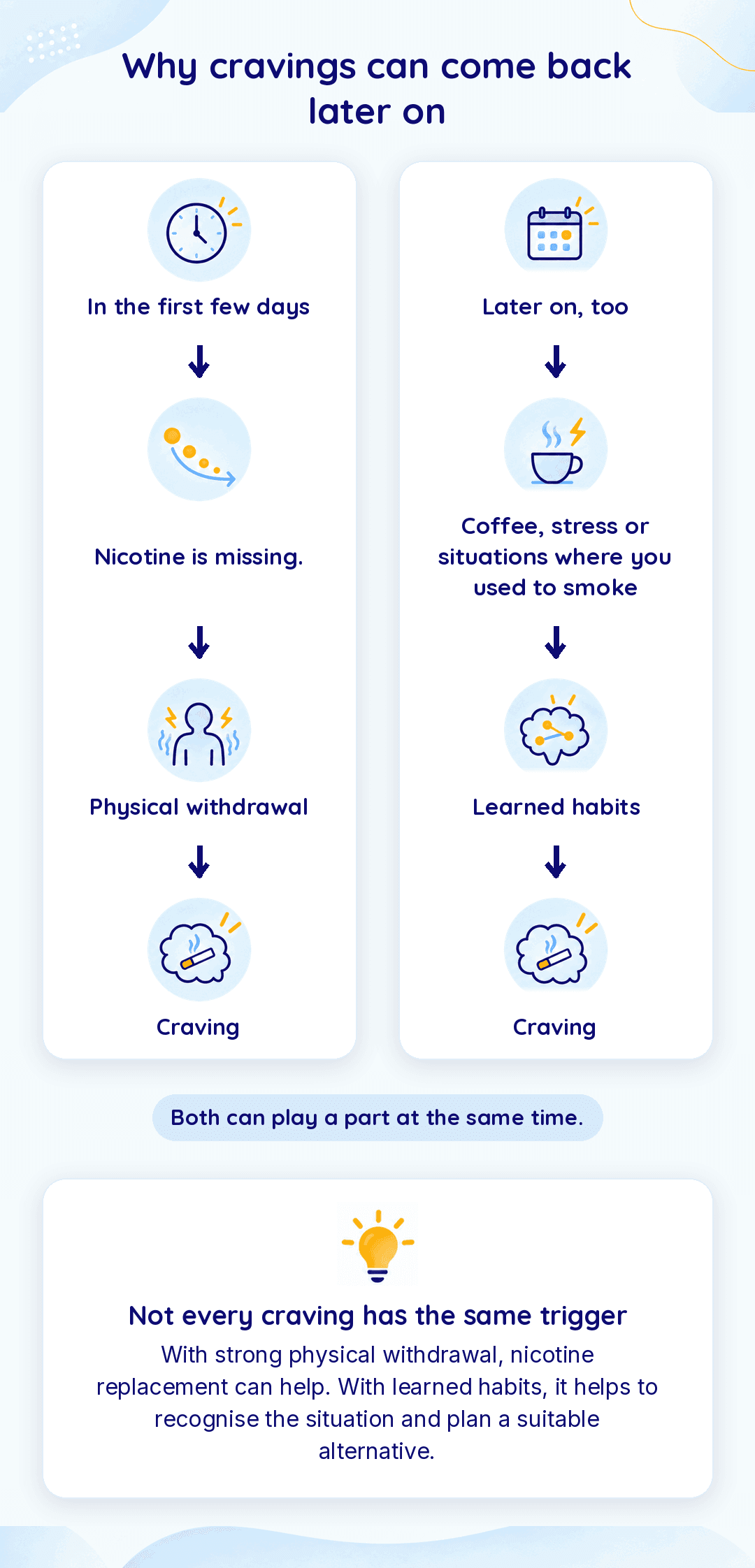
This also affects which strategy suits you best. With strong physical withdrawal, for example, nicotine replacement can be a useful support.1 If the craving keeps coming back after work, it helps to ask what used to be linked with smoking at that moment and what would be good for you instead now.1 Physical withdrawal and learned habits can both be involved at the same time.
Even when physical withdrawal has already eased off, habits, feelings and certain situations can still trigger cravings.
If withdrawal is very strong, you don't have to just grit your teeth
Psychological strategies can be helpful. But they don't mean you have to get through withdrawal just with acceptance, exercise or self-monitoring.
Nicotine replacement products such as patches or gum can reduce physical withdrawal symptoms and cravings. There are also medicines that help you quit smoking. If you have withdrawal symptoms, it's worth considering these options. It can also help to get support while you quit, for example through an app, counselling or a course. The two can be combined.110
Which option suits you depends, among other things, on how strong your nicotine dependence is and on your health.1 Especially if withdrawal is very distressing or previous attempts to quit have repeatedly failed in the first few days, it can make sense to get advice from a doctor or pharmacist.
Using support does not mean you lack willpower. Nicotine dependence has a physical and a psychological side. You can work on both sides when you quit.
What support helps you in everyday life
You don't have to find a solution for every symptom straight away. Start with the symptom that is weighing on you most right now. A craving calls for a different approach than a restless night or a task you can hardly concentrate on.
With Khema, you can talk about which situations you find particularly difficult and which kind of support suits you. From your conversations and your entries in the Craving Tracking, you gradually develop strategies together that fit into your everyday life. You don't need to know yet what is behind each craving.
This article does not replace medical or therapeutic advice. If you keep struggling with strong cravings or relapses, talk to your doctor or an addiction counselling service about additional support.
Sources
-
Association of the Scientific Medical Societies in Germany (AWMF), S3 guideline "Smoking and tobacco dependence: screening, diagnosis and treatment", register no. 076-006, long version (2021, in German), Online source ↩ ↩2 ↩3 ↩4 ↩5 ↩6 ↩7 ↩8 ↩9 ↩10 ↩11 ↩12 ↩13 ↩14
-
Batra, A. & Buchkremer, G.: "Tabakentwöhnung. Ein verhaltenstherapeutisches Manual" (Smoking cessation: a behavioural therapy manual), 2nd extended and revised edition, W. Kohlhammer, Stuttgart (2025, in German), pp. 28, 33 and 118, Online source ↩ ↩2 ↩3 ↩4 ↩5 ↩6 ↩7
-
Federal Institute for Public Health (BIÖG), Physical dependence (accessed 2026, in German), Online source ↩ ↩2
-
National Cancer Institute, Tips for Coping with Nicotine Withdrawal and Triggers (accessed 2026), Online source ↩ ↩2 ↩3 ↩4
-
Taylor, G. M. J. et al.: "Smoking cessation for improving mental health", Cochrane Database of Systematic Reviews, CD013522 (2021), Online source ↩
-
Centers for Disease Control and Prevention, 7 Common Withdrawal Symptoms (accessed 2026), Online source ↩
-
Hughes, J. R.: "Effects of abstinence from tobacco: valid symptoms and time course", Nicotine & Tobacco Research 9(3), 315–327 (2007), Online source ↩
-
NHS, Better Health, Managing nicotine withdrawal symptoms (accessed 2026), Online source ↩ ↩2
-
NHS, Better Health, Understand your smoking triggers and cravings (accessed 2026), Online source ↩
-
World Health Organization, WHO clinical treatment guideline for tobacco cessation in adults (2024), Online source; official summary of the recommendations, Online source ↩
Khema is funded by the German Federal Ministry for Economic Affairs and Energy and the European Union (ESF Plus) through the EXIST Business Start-up Grant.