Understanding your cravings: how Craving Tracking helps you
Narrated by an AI voice
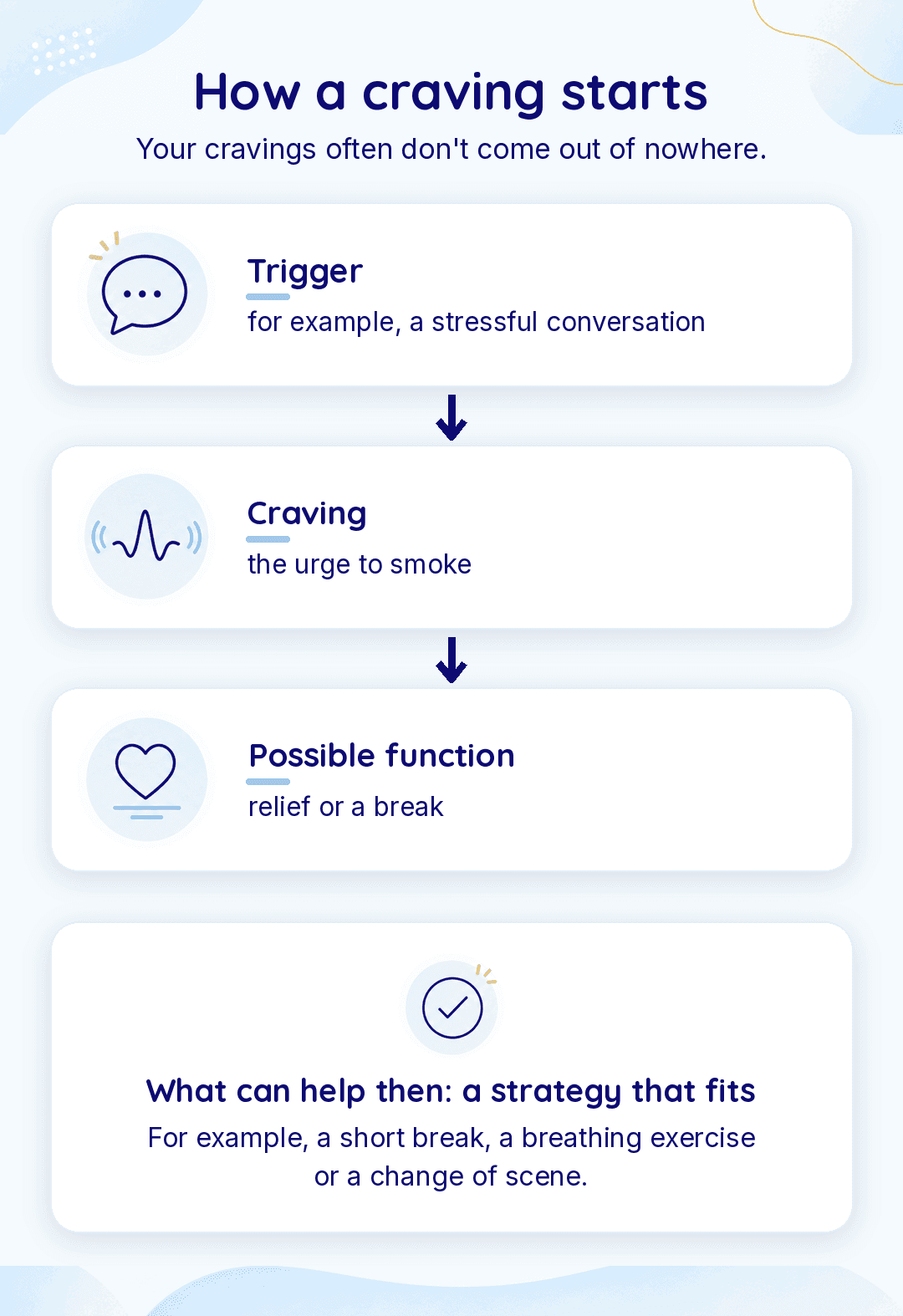
If you are quitting smoking, you probably know these moments: everything was actually fine and suddenly the craving is there. With your first coffee in the morning, after a good meal, in the evening with friends, after a stressful conversation or simply because there is nothing to do right now. Moments like these can feel as if they come out of nowhere. Often, though, the craving is linked to situations, feelings or habits that have been connected with smoking over a long time.1
Maybe you do not smoke because something weighs on you, but because you enjoy it. Even then it is worth taking a closer look, because enjoyment, too, is usually tied to very specific moments. Your craving does not just tell you that you want to smoke right now. It can also give you clues about what triggered your craving and what role smoking has played in this situation so far.
Smoking often serves a function
Smoking is often more than just a habit. Over time, it can take on very different roles in everyday life.2 Maybe it helps you unwind after a tiring day at work. Maybe it is your little reward in between, an essential part of your morning coffee or something to do at a party when you feel uncomfortable.
Smoking can, for example, help you cope with stress or unpleasant feelings, take a break, reward yourself, get through boredom or make social situations feel easier. But it can also simply have become a fixed ritual.23
The crucial point is this: when smoking stops, the need behind it does not automatically go away with it. If smoking was your way of relieving stress, you now need a new one. The good news is that part of this stress came from nicotine withdrawal between cigarettes. That part fades after a few weeks without smoking.2 If smoking was your reward after a long day at work, your need for a reward remains. That is why it helps to understand what role smoking plays for you personally.
This is exactly where tracking helps you
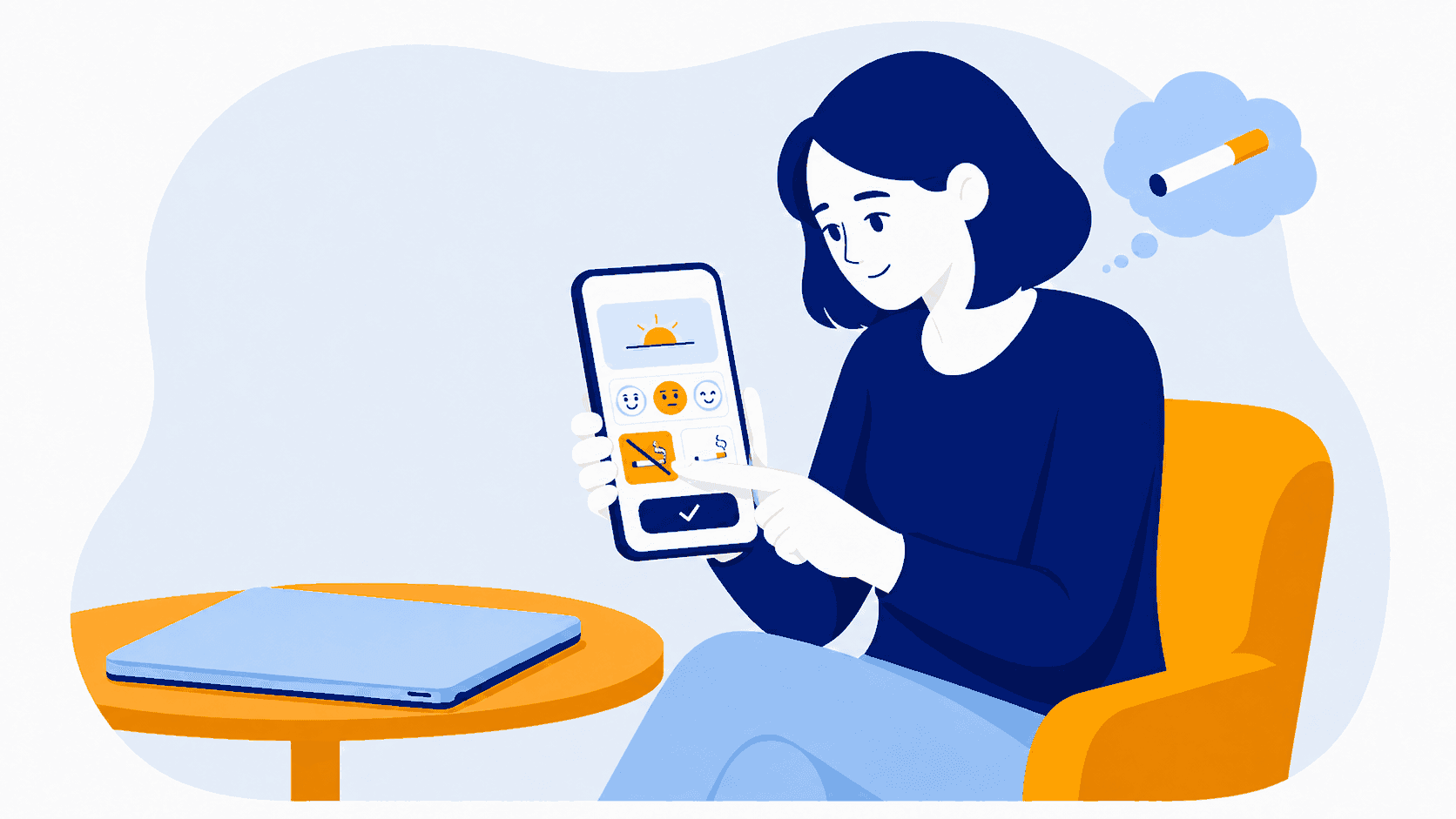
When you track your cravings, you record the situations in which they come up. The point is not to pick apart every thought about smoking. At first, you simply collect information: How strong is your craving? How are you feeling right now? What are you doing right now? Did you smoke or resist?
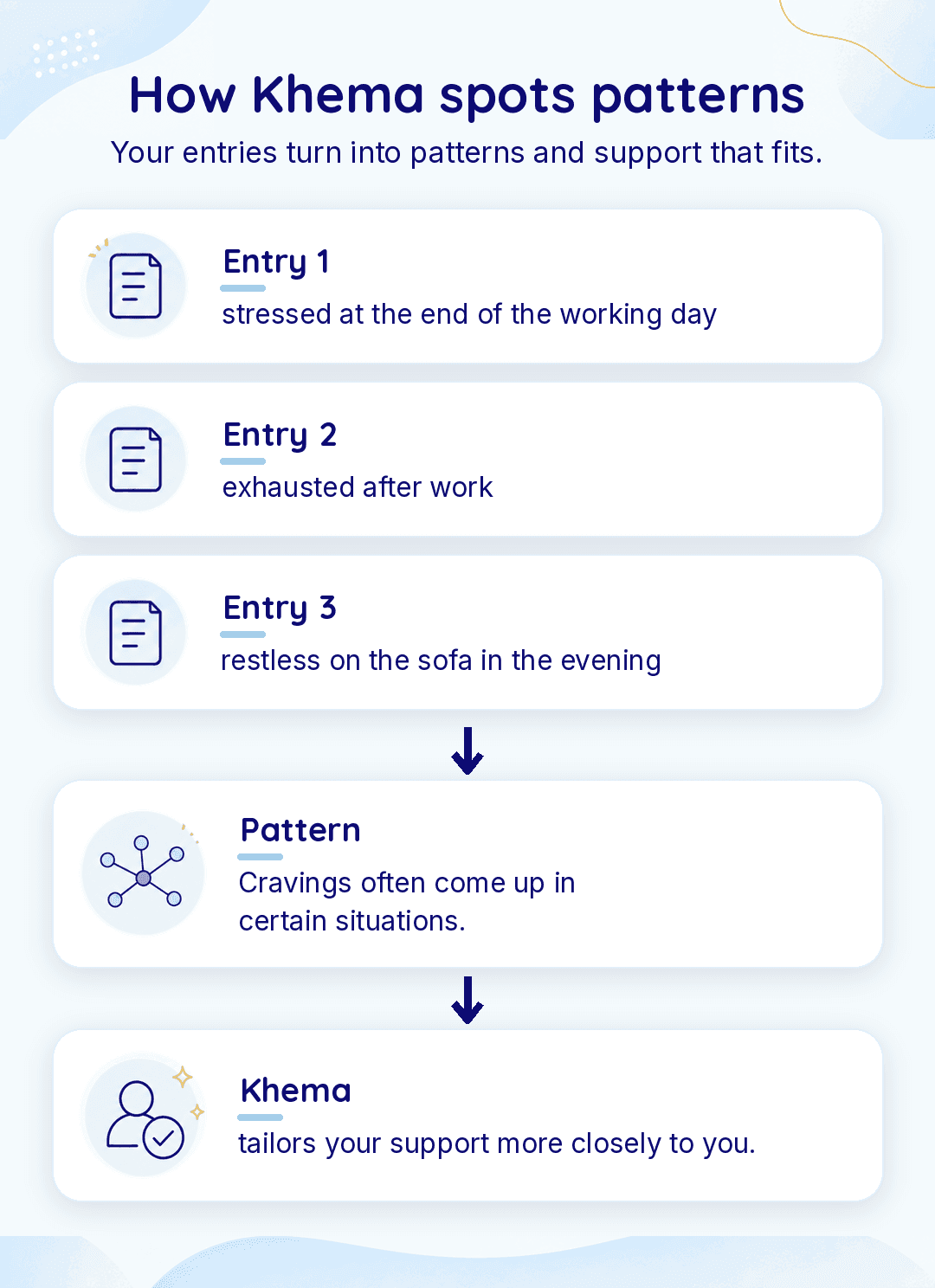
A single entry may not say much yet. With several entries, however, patterns can become visible. Self-monitoring and analysing your own smoking behaviour are also among the methods used in behavioural therapy for quitting smoking.3
Maybe you notice that your cravings come up especially often after stressful situations, or whenever you have finished a task. Maybe they come mainly in the evening on the sofa or when other people around you are smoking. Bit by bit, individual situations build up a clearer picture of your personal smoking patterns. A vague "I just crave cigarettes all the time" turns into something you can work with more concretely.
Trigger and function are not the same
It is worth distinguishing between two things here. The trigger describes what set your craving off. The function describes what role smoking has played for you in this situation so far.3
Let's say your craving regularly comes up after work. Finishing work is, first of all, the trigger. But why do you want to smoke at exactly that moment? Maybe after eight hours of work you need a break, want to reward yourself or want to consciously bring the working day to a close.
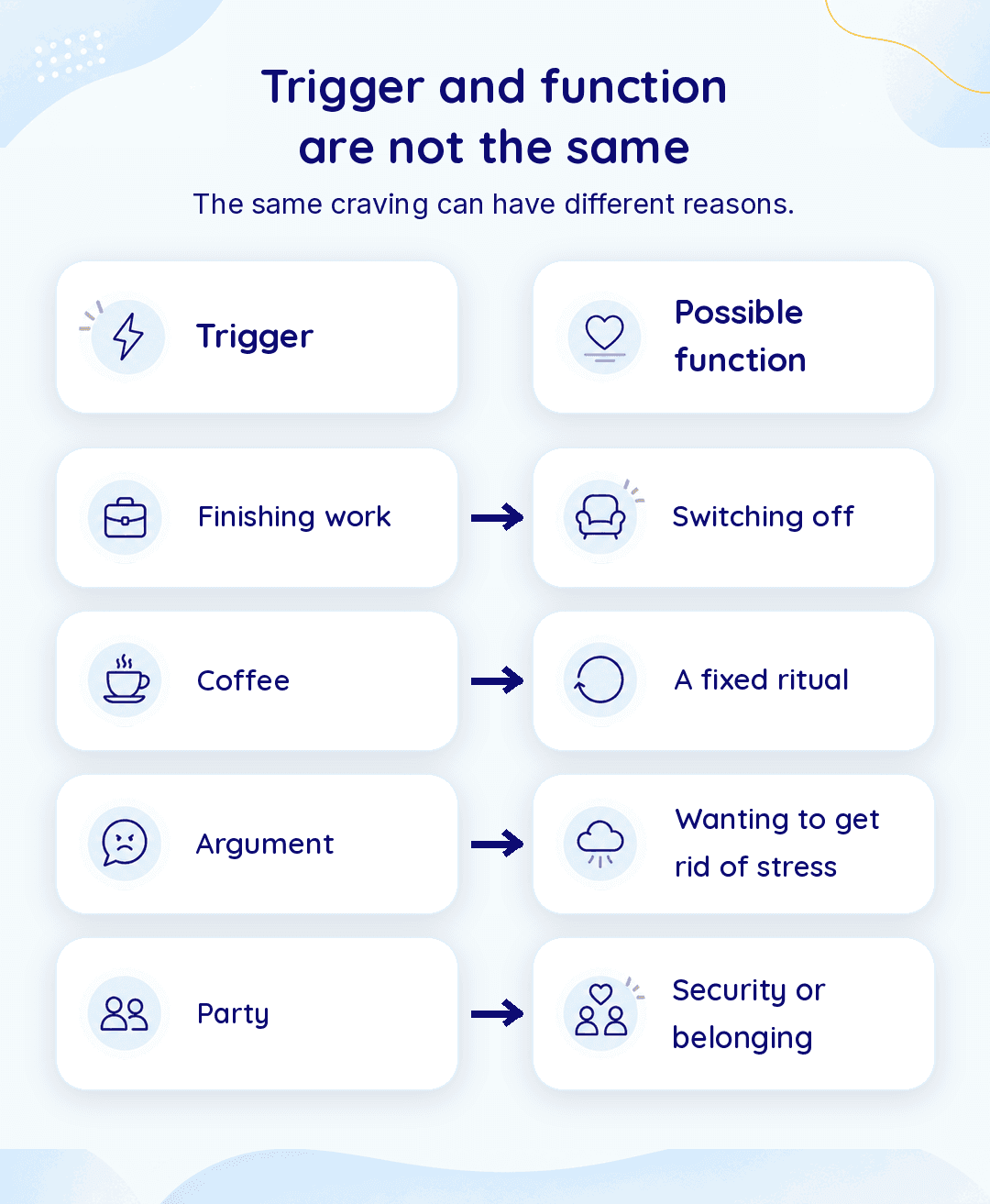
From the outside, the craving looks similar every time. But there can be different reasons behind it. These very differences matter when you want to find out what can help you in each situation.
Why the same strategy does not suit everyone
You may have heard the tip to drink a glass of water, chew gum or distract yourself when a craving hits. Strategies like these are indeed recommended for dealing with acute cravings.14 Even so, not every strategy has to suit you equally well in every situation.
If what you actually need is a break, it can make sense to deliberately take a break without smoking. If smoking was a reward for you, you can try out what else you would like to meet this need with instead. And if a particular routine triggers your craving, it can help to change exactly that routine.5
The better you know your own triggers and patterns, the more specifically you can try out which strategies suit you and your everyday life in each situation.
Not every craving has a psychological function
It would be too simple, though, to put every craving down to a particular need. Especially after quitting, nicotine withdrawal itself can trigger cravings.6 Your body and brain first have to get used to no longer getting nicotine. In this phase in particular, the craving can therefore also come up without a specific feeling or need directly behind it.
Sometimes the craving also comes up simply because a situation has been closely linked with smoking for a long time. Your morning coffee, waiting for the bus, driving or your break at work can become triggers for cravings through frequent repetition.25 That is important information too. Because once you know your typical triggers, you can prepare for them better and gradually build new habits.
So tracking does not mean overthinking every craving. It is much more about getting to know your own patterns and understanding better when and why cravings come up for you.
You don't have to know your patterns yet
Maybe right now you have no idea why you get cravings in certain situations. You don't need to. That is exactly why you track your cravings.
With every entry, you collect a little more information. Bit by bit, it can become clear which situations keep coming up for you and what role smoking has played in them so far. Instead of just thinking "I mustn't smoke now" every time a craving hits, over time you can ask yourself a different question: "What just triggered my craving, and what do I need in this situation?"
That is something you can respond to much more concretely.
Find out what is behind your cravings
This is exactly where Khema supports you. When a craving comes up, you can record the situation straight away. You don't need to know yet why it came up or what you want to do differently next time. First of all, you simply collect information.
Khema has access to your entries and can therefore recognise recurring patterns in your cravings. Over time, this shows which situations trigger cravings particularly often and which feelings play a role. This information helps Khema tailor your support even more closely to your personal smoking patterns.
So you don't have to go to the trouble of analysing your entries yourself. The more you track your cravings, the clearer the picture of what is behind them and where you can make targeted changes.
Log your next craving and find out what your smoking patterns reveal.
This article does not replace medical or therapeutic advice. If you keep struggling with strong cravings or relapses, talk to your doctor or an addiction counselling service about additional support.
Sources
-
Federal Institute for Public Health (BIÖG), Tips for craving attacks (in German), https://www.rauchfrei-info.de/tipps/tipps-bei-verlangensattacken/ ↩ ↩2
-
Federal Institute for Public Health (BIÖG), Psychological dependence (in German), https://www.rauchfrei-info.de/infozentrum/meine-gesundheit/abhaengigkeit/psychische-abhaengigkeit/ ↩ ↩2 ↩3 ↩4
-
AWMF, S3 guideline "Smoking and tobacco dependence: screening, diagnosis and treatment" (in German), https://register.awmf.org/assets/guidelines/076-006l_S3_Rauchen-_Tabakabhaengigkeit-Screening-Diagnostik-Behandlung_2021-03.pdf ↩ ↩2 ↩3
-
Federal Institute for Public Health (BIÖG), Tips for withdrawal symptoms (in German), https://www.rauchfrei-info.de/tipps/bei-entzugserscheinungen/ ↩
-
National Cancer Institute, Smokefree.gov, Know Your Smoking Triggers, https://smokefree.gov/challenges-when-quitting/cravings-triggers/know-your-triggers ↩ ↩2
-
NHS, Understand your smoking triggers and cravings, https://www.nhs.uk/better-health/quit-smoking/staying-smoke-free/understand-your-smoking-triggers-and-cravings/ ↩
Khema is funded by the German Federal Ministry for Economic Affairs and Energy and the European Union (ESF Plus) through the EXIST Business Start-up Grant.