What's in a cigarette?
Narrated by an AI voice
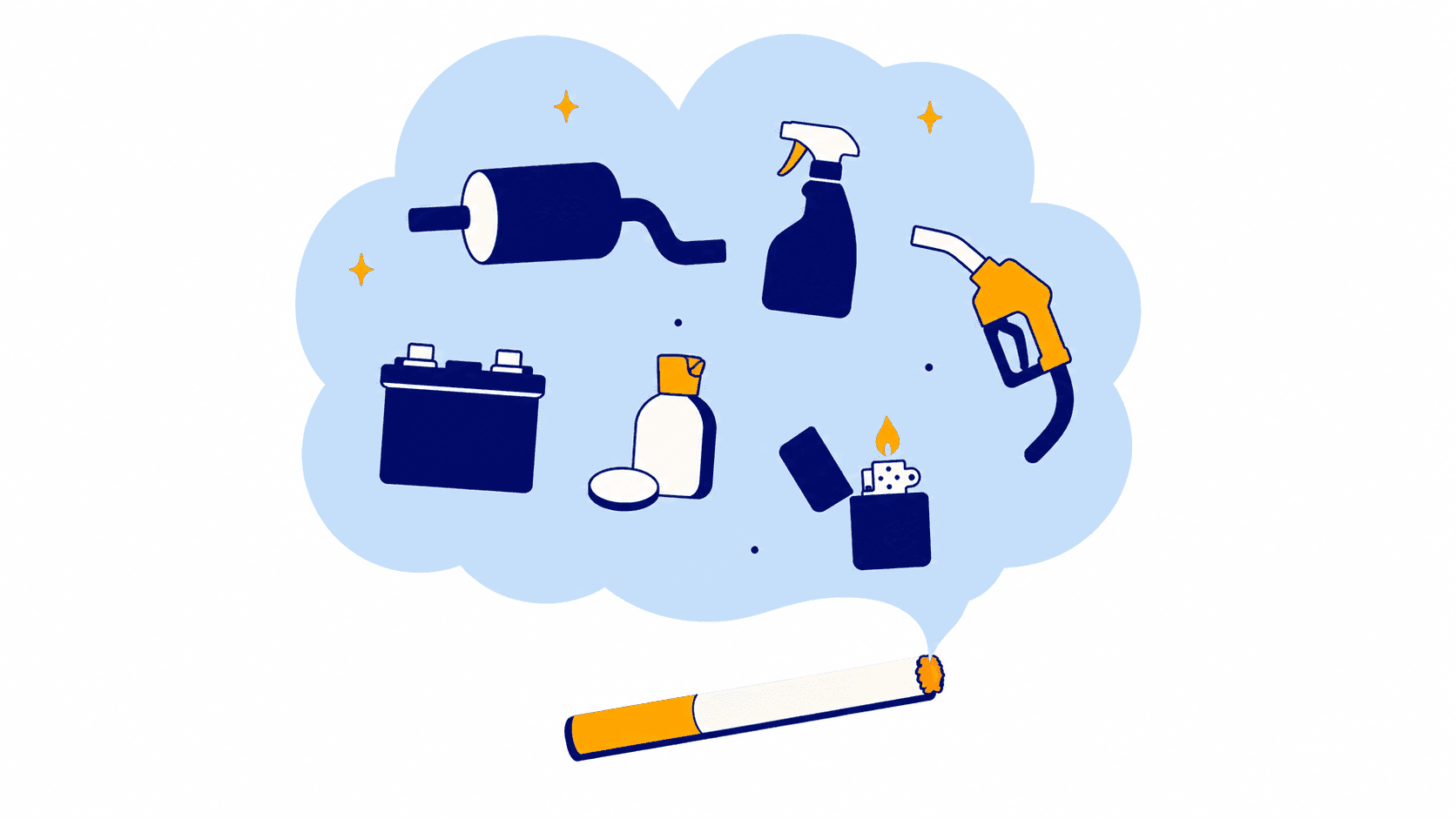
Nobody would willingly take a drag from an exhaust pipe, sniff a petrol can or deliberately breathe in the fumes of a harsh cleaning product. Yet when you smoke, some of these very substances end up in your lungs, just well hidden behind a familiar taste and a deeply rooted habit.1 But how do these substances end up in a cigarette in the first place, what exactly do they do in your body and why are they addictive?
Most of it only forms when you light up
Surprisingly, most of these substances are not in the tobacco itself. Most of them are only created when the cigarette is lit. When tobacco burns, thousands of new compounds form that were not in the tobacco before.1 Most of the particles in the smoke settle deep in the lungs.2 Other substances in the smoke, such as hydrogen cyanide and ammonia, damage the tiny hairs that are supposed to keep the airways clean.1 All in all, more than 7,000 chemicals have been found in tobacco smoke. At least 250 of them are harmful to health, and around 90 are considered carcinogenic or possibly carcinogenic.34 So-called light cigarettes do little to change this. People who smoke them can end up taking in just as much tar and nicotine as they would from regular ones.5 On top of that, their risk of lung cancer rises about as much as it does with regular ones.6
Where else you come across the same substances
Here is a closer look at some of them:1
- Carbon monoxide, the same odourless gas that comes out of an exhaust pipe. In the blood it pushes out oxygen, and the heart and brain in particular are sensitive to this.7
- Ammonia, which you know from harsh cleaning products. Even small amounts irritate the eyes and airways.
- Arsenic, which you may know from rat poison and which is carcinogenic.
- Cadmium, a heavy metal used in batteries. It is carcinogenic and can damage the kidneys over time.
- Formaldehyde, which is used in wood processing and as a preservative. It irritates the eyes and airways and is carcinogenic.
- Benzene, which is also found in petrol. It is carcinogenic and can lead to blood cancer.
- Hydrogen cyanide, one of the most toxic substances in tobacco smoke.
Both individual substances and the mixture as a whole are dangerous. Some of them do serious damage on their own. Certain hydrocarbons in the smoke in particular cause tumours in the airways. Others damage the tiny hairs in the airways, so the carcinogenic particles stay in the lungs longer and have a stronger effect. There is no safe amount, and the more someone smokes and the longer they smoke, the higher the cancer risk.14
Where the addiction comes from
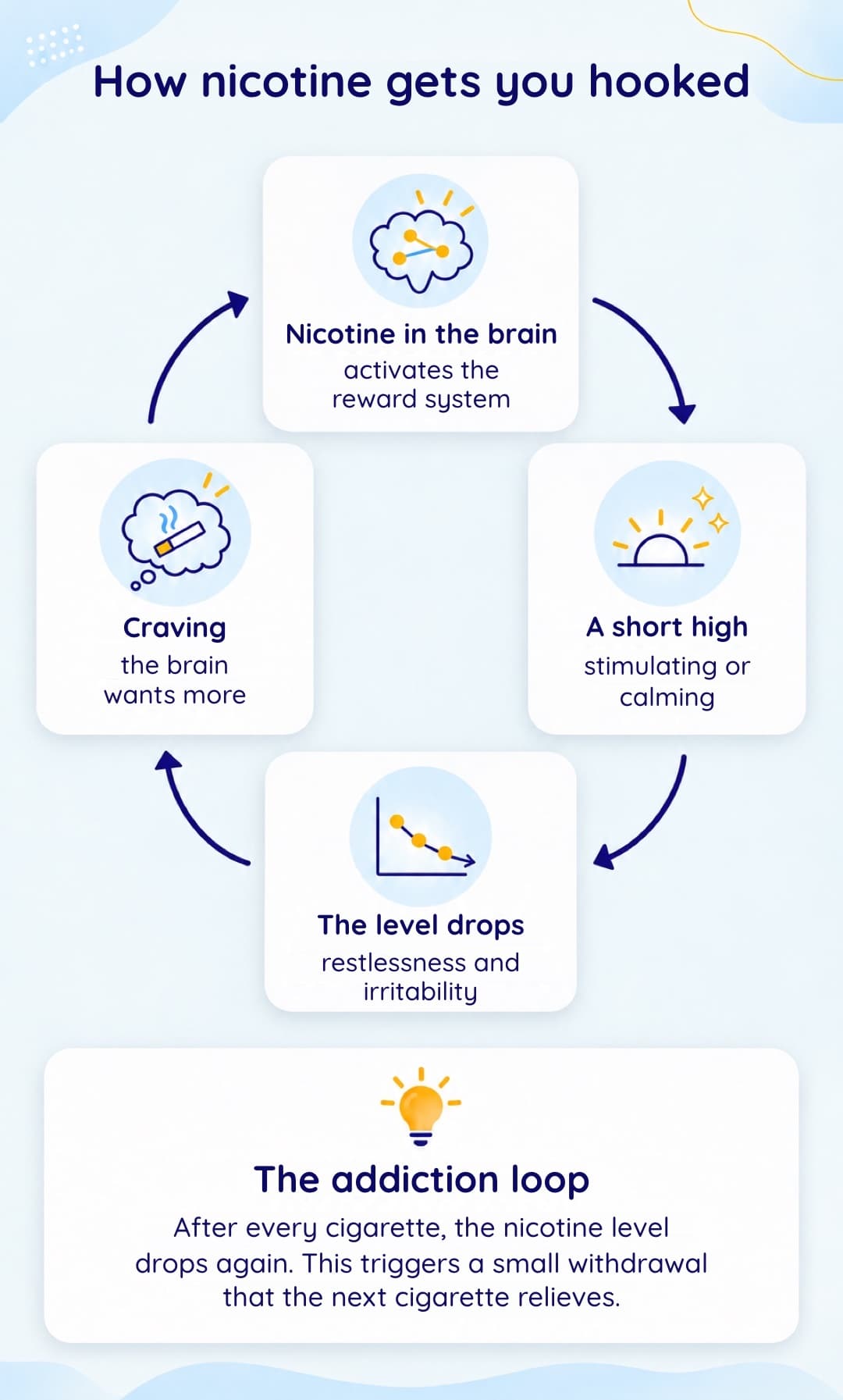
One substance is still missing from the list, and it is the one that makes you reach for a cigarette again and again: nicotine. Via the large surface area of the lungs, it quickly enters the blood and from there reaches the brain just a few seconds after a drag, where it activates the reward system.18 It feels stimulating at times and calming at others, and this good feeling helps to keep people smoking.18 But the high does not last long. When the nicotine level drops again between cigarettes, many smokers feel restless and irritable, and the brain craves the next cigarette. And so the cycle starts all over again. What feels like relaxation is probably, to a large extent, the easing of a small withdrawal that has built up since the last cigarette.98
Then there are various additives. Among other things, ammonium compounds are added to the tobacco, and when it smoulders they release ammonia, the same substance from the list above. Additives like these can make cigarettes more pleasant. This encourages smoking and makes it more likely that people become dependent.10
Because nicotine is the real hook in the end, the dependence often remains when people switch to e-cigarettes or vapes, as most of them contain nicotine. Their vapour contains fewer harmful substances than tobacco smoke, but it still contains harmful and in some cases carcinogenic substances.11 However, for people who have not managed to quit with proven methods, e-cigarettes can help. In that case they should switch completely and, in the longer term, stop using e-cigarettes too.11
What this means for you
That may sound like a lot at first. The good news is that your body starts to recover as soon as it stops getting smoke.12 The level of carbon monoxide in the blood, for example, halves within just a few hours, so your blood can carry more oxygen again.7 Other things take more time. The increased risk of coronary heart disease falls quickly at first after quitting and then more slowly, and the risk of lung cancer also declines over the years.13 The physical side of the dependence fades too. Your brain has got used to a constant supply of nicotine, and after quitting this adaptation gradually reverses.814 Withdrawal symptoms often last for days or weeks and then ease off. In certain situations, though, the urge to smoke can come back even years later.8 This happens to many people, but only a few find it really distressing.15
If you would like to understand better when your cravings show up and what patterns lie behind them, you can find out more in our blog post "Understanding your cravings: how Craving Tracking helps you". And if you are thinking about smoking less or quitting altogether, we at Khema are here to support you. In conversations tailored to you, we look together at what is behind your smoking and what helps you. All you need to do is download the Khema app for free. On the home screen, under "Achievements" in the "Health" category, you can also see how your body recovers after you quit.
Sources
-
German Cancer Research Center (DKFZ), Facts on smoking: Tobacco smoke, a toxic mixture (2008, in German), https://www.dkfz.de/fileadmin/user_upload/Krebspraevention/Download/pdf/FzR/FzR_2008_Tabakrauch-ein-Giftgemisch.pdf ↩ ↩2 ↩3 ↩4 ↩5 ↩6 ↩7
-
U.S. Department of Health and Human Services, How Tobacco Smoke Causes Disease: A Report of the Surgeon General (2010), Chapter 3, p. 51, https://www.ncbi.nlm.nih.gov/books/NBK53017/ ↩
-
National Cancer Institute, Harms of Cigarette Smoking and Health Benefits of Quitting, https://www.cancer.gov/about-cancer/causes-prevention/risk/tobacco/cessation-fact-sheet ↩
-
German Cancer Research Center (DKFZ), Facts on smoking: Carcinogenic substances in tobacco smoke (2009, in German), https://www.dkfz.de/fileadmin/user_upload/Krebspraevention/Download/pdf/FzR/FzR_2009_Krebserzeugende-Substanzen-im-Tabakrauch.pdf ↩ ↩2
-
National Cancer Institute, Smoking and Tobacco Control Monograph 13: Risks Associated with Smoking Cigarettes with Low Machine-Measured Yields of Tar and Nicotine (2001), preface, https://cancercontrol.cancer.gov/sites/default/files/2020-06/m13_preface.pdf ↩
-
Harris JE, Thun MJ, Mondul AM, Calle EE (2004): Cigarette tar yields in relation to mortality from lung cancer in the cancer prevention study II prospective cohort, 1982-8. BMJ 328:72, https://pubmed.ncbi.nlm.nih.gov/14715602/ ↩
-
Agency for Toxic Substances and Disease Registry (ATSDR), Toxicological Profile for Carbon Monoxide (2012), Chapter 2, pp. 9, 11 and 13, https://www.atsdr.cdc.gov/toxprofiles/tp201-c2.pdf ↩ ↩2
-
AWMF, S3 guideline "Smoking and tobacco dependence: screening, diagnosis and treatment", version 3.1, as of 1 January 2021, long version pp. 28 to 31 and 37 (in German), https://www.awmf.org/leitlinien/detail/ll/076-006.html ↩ ↩2 ↩3 ↩4 ↩5
-
Benowitz NL (2010): Nicotine addiction. New England Journal of Medicine 362:2295–2303, https://pmc.ncbi.nlm.nih.gov/articles/PMC2928221/ ↩
-
German Cancer Research Center (DKFZ), Increased health risk from tobacco additives: ammonium compounds (2012, in German), https://www.dkfz.de/fileadmin/user_upload/Krebspraevention/Download/pdf/FS/FS_2012_PITOC_Tabakzusatzstoffe_Ammoniumverbindungen.pdf ↩
-
German Cancer Research Center (DKFZ), Facts on smoking: Health risks of e-cigarettes (2024, in German), https://www.dkfz.de/fileadmin/user_upload/Krebspraevention/Download/pdf/FzR/FzR_2024_E-Zigaretten.pdf ↩ ↩2
-
U.S. Department of Health and Human Services, The Health Benefits of Smoking Cessation: A Report of the Surgeon General (1990), summary in MMWR, https://www.cdc.gov/mmwr/preview/mmwrhtml/00001801.htm ↩
-
U.S. Department of Health and Human Services, Smoking Cessation: A Report of the Surgeon General (2020), p. 8, https://www.hhs.gov/sites/default/files/2020-cessation-sgr-full-report.pdf ↩
-
Cosgrove KP et al. (2009): β2-Nicotinic acetylcholine receptor availability during acute and prolonged abstinence from tobacco smoking. Archives of General Psychiatry 66:666–676, https://pubmed.ncbi.nlm.nih.gov/19487632/ ↩
-
Hughes JR (2010): Craving among long-abstinent smokers: an Internet survey. Nicotine & Tobacco Research 12:459–462, https://pubmed.ncbi.nlm.nih.gov/20164170/ ↩
Khema is funded by the German Federal Ministry for Economic Affairs and Energy and the European Union (ESF Plus) through the EXIST Business Start-up Grant.