Quitting smoking without gaining weight? How to keep weight gain in check
Narrated by an AI voice
The belief that smoking keeps you slim is remarkably persistent. As far back as the 1930s, cigarette advertising told women to reach for a cigarette instead of something sweet.1 It isn't entirely wrong, because nicotine dampens hunger.2 Perhaps you know the worry behind it: what if I gain weight after quitting? In reality, it varies from person to person. Most people do put on some weight after they stop smoking. But about one in six people actually weighs less a year later than they did before.3 So it is possible to quit smoking without gaining weight. There is no guaranteed way to prevent weight gain, but there are things you can do to counteract it.4 And even if a few kilos do creep on, quitting is still worth it for your health.
How much weight do people gain after quitting smoking?
On average, people gain around four to five kilos in the first year after quitting. Most of this happens in the first three months.3 After that, weight can keep rising, but more slowly.5 So if you have only just quit and the scales are going up, that doesn't mean it will carry on at the same pace.
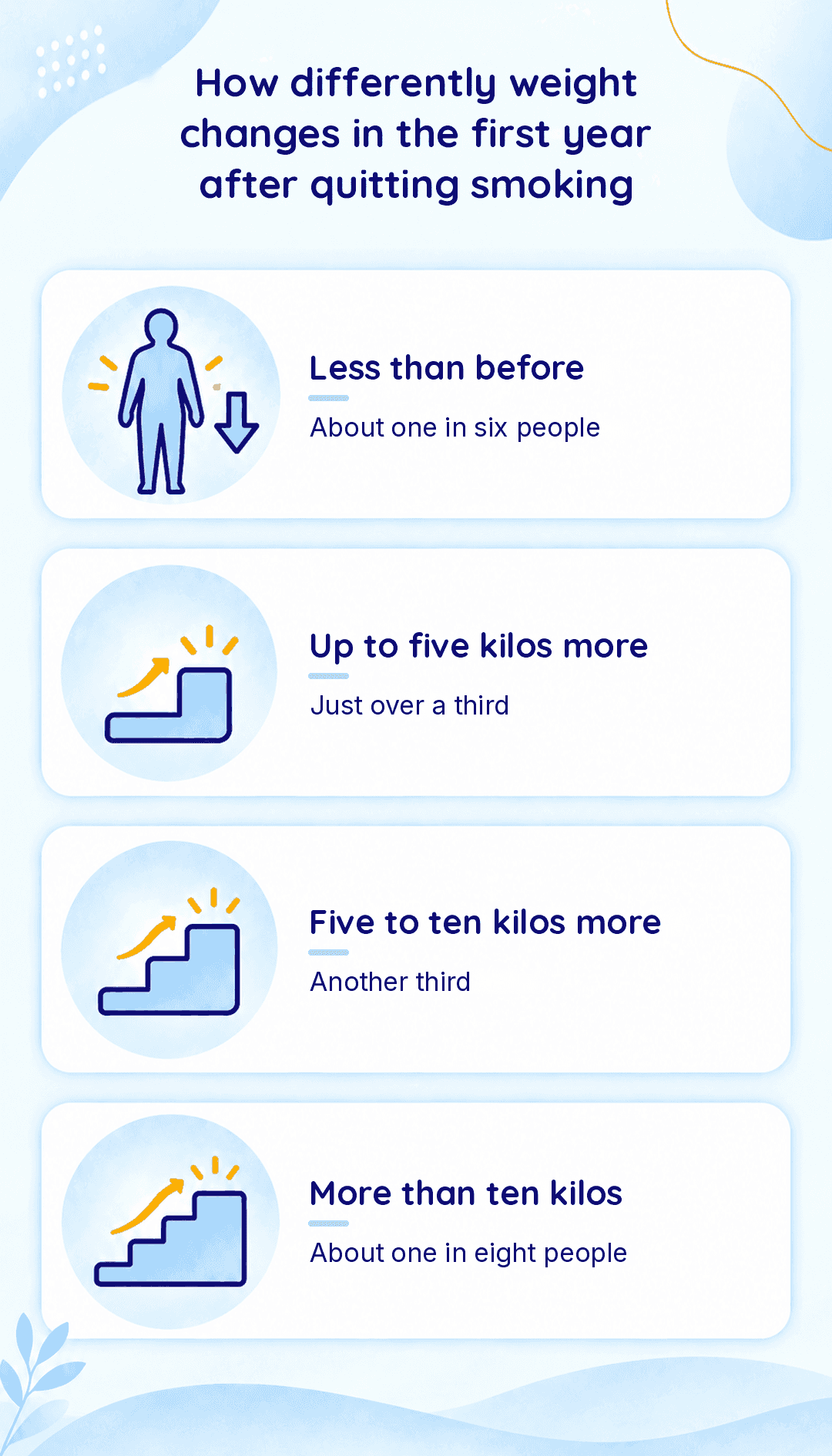
Your own experience may look different from the average, though, because the differences between people are large. A year after quitting, about one in six people weighs less than before. Just over a third gain less than five kilos, and another third gain five to ten kilos. For about one in eight people, it is more than ten kilos. You may be wondering which group you will end up in. Either way, how much you worry about your weight doesn't decide it: people who are very worried don't gain more than others.3 But to some extent you can influence it yourself, for example by being more active or by paying attention to what you eat.
People who smoke weigh a few kilos less on average than people who have never smoked. After quitting, the body slowly catches up. A few years later, people weigh roughly as much as those who have never smoked.6
Why do people gain weight after quitting smoking?
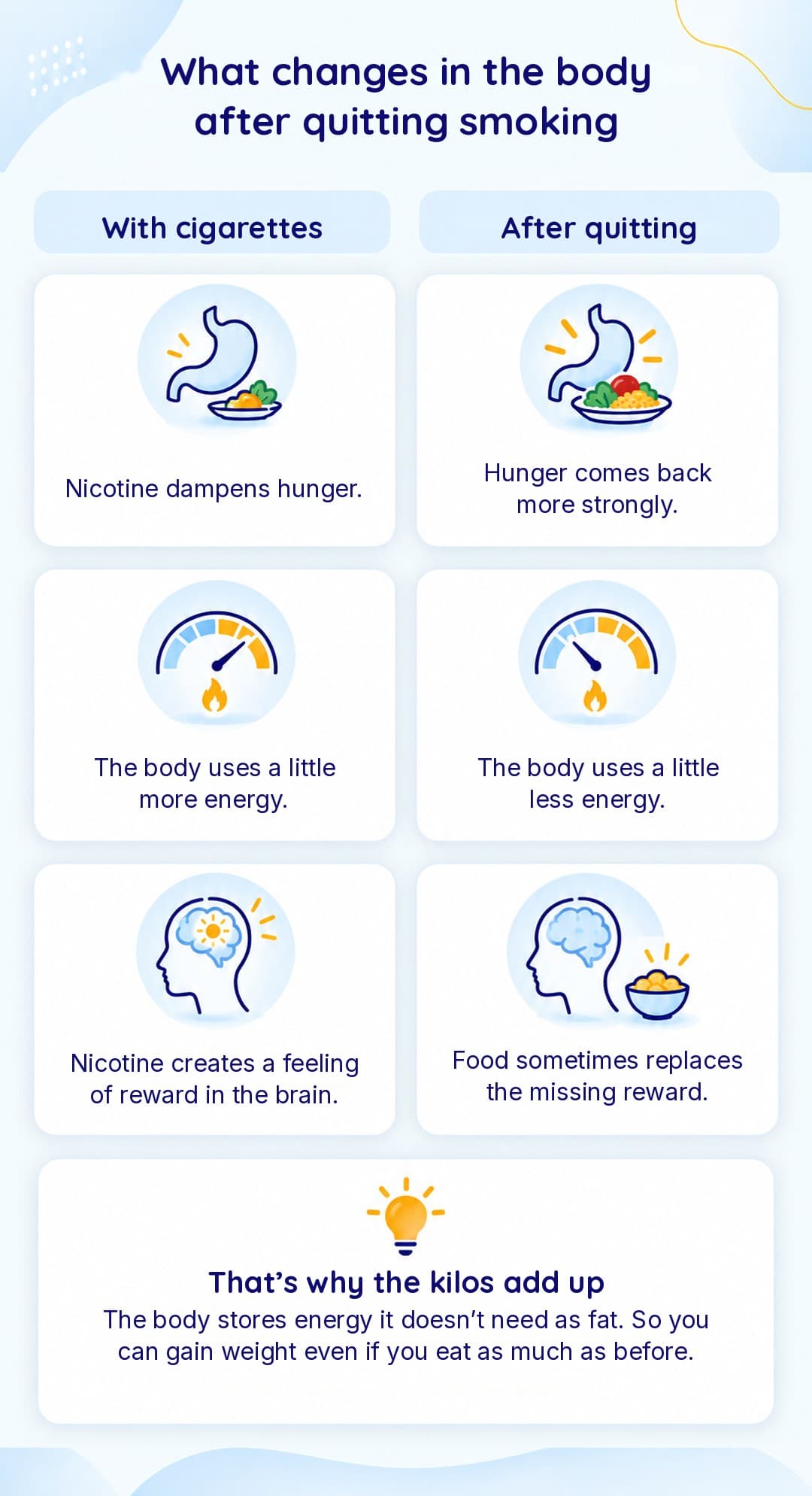
Nicotine affects weight in two ways. First, it dampens hunger, so you feel less hungry when you smoke. Second, it slightly increases the amount of energy your body burns, even when you aren't doing anything in particular.1 After quitting, both of these effects disappear: hunger comes back more strongly, while at the same time your body uses slightly less energy than before. The energy it doesn't need, it stores as fat.7 That is why you can gain some weight even if you eat exactly as much as you used to. Often, though, people actually eat more after quitting, partly because increased appetite is one of the typical withdrawal symptoms.2
Then there is habit. Think of the moments when you used to reach for a cigarette. For some people, it was also a kind of substitute for food in those moments.1 Nicotine also triggers the release of dopamine, a brain chemical linked to a feeling of reward.2 When the cigarette is gone, this small reward is missing. That is why some people turn to food instead, and they tend to reach for sweet foods and other snacks high in carbohydrates.1
Is quitting worth it despite the extra kilos?
Yes! Your body starts to recover soon after your last cigarette. After a few weeks to months, your lungs work better, and coughing and shortness of breath decrease. After a year, the risk of coronary heart disease is only half as high as for people who keep smoking.8 Even with a few extra kilos, it pays off for your heart: in the years afterwards, people who had quit died less often from cardiovascular disease than people who kept smoking. That was true even if they had gained more than ten kilos.9 The picture was similar for overall mortality. There was no temporary increase in the risk of death after quitting, no matter how much weight someone had gained.9
There is one small catch: the risk of type 2 diabetes, the most common form of diabetes,10 is somewhat higher for a while after quitting and then falls again. How much the risk rises depends on how much weight someone gains.9
So for your heart and your health as a whole, quitting is the better choice despite the extra kilos.
What helps against weight gain after quitting smoking?
If the kilos worry you, it is worth keeping them in mind from the start. People who gain weight after quitting are more likely to start smoking again.2 That is why this section gives you tips to help you counteract weight gain. In the first few months, though, staying off cigarettes matters more than any number on the scales.
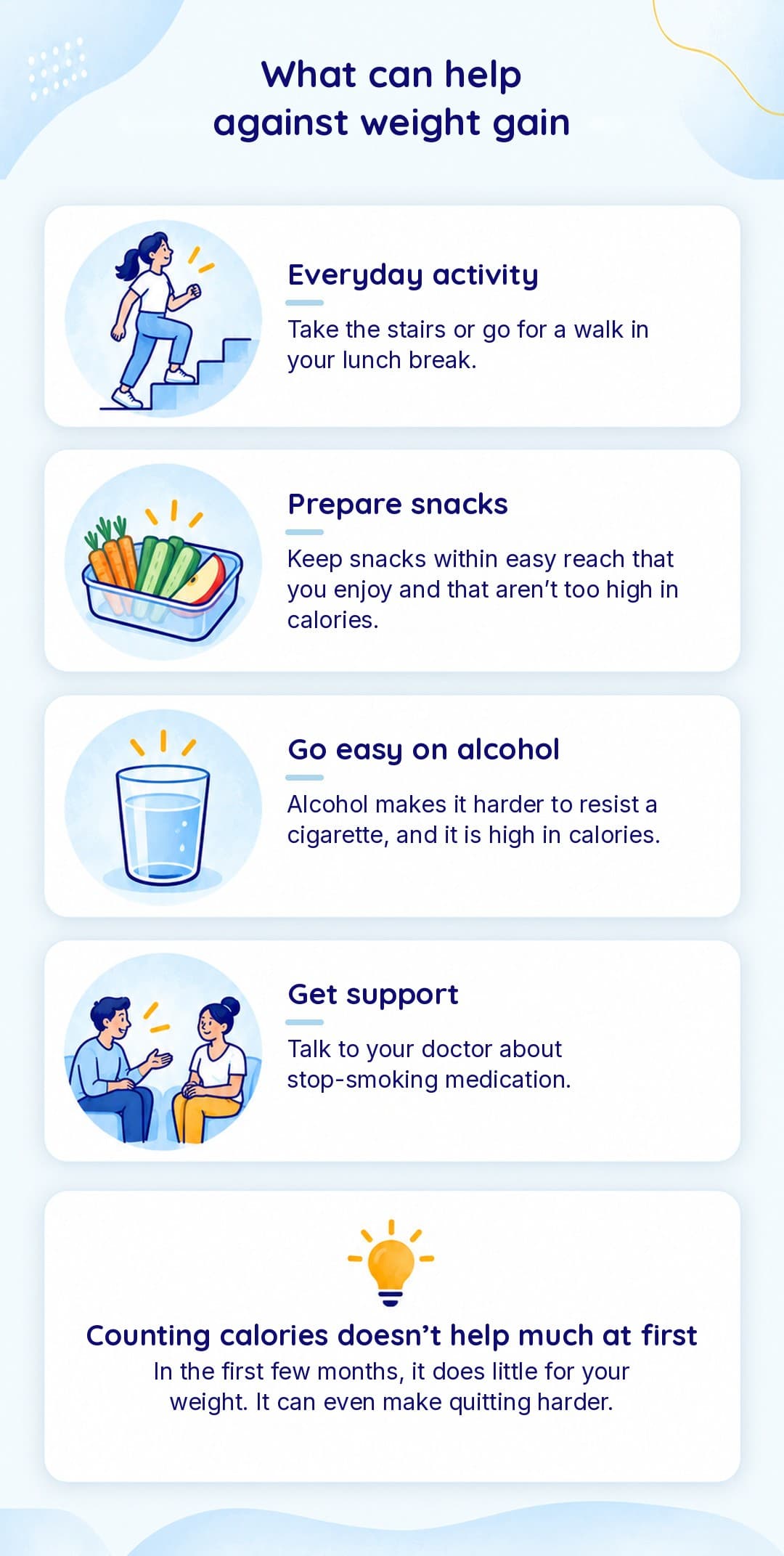
Regular exercise can be worthwhile, even if you don't notice the difference straight away. People who exercised regularly had gained about two kilos less on average after a year.4 You don't have to head straight to the gym for this. Taking the stairs, getting off two stops early, going for a walk in your lunch break: small things like these already add more activity to your day.11
When it comes to food, a little preparation can help. Make a list of snacks that aren't too high in calories and that you enjoy. These could be carrot or cucumber sticks, fruit, a wholegrain sandwich with tomato and cucumber, or a glass of tomato juice. Keep some of them within easy reach, so you don't have to think about it once the hunger has already hit.10
It also helps to drink little or no alcohol in the first weeks and months. Alcohol makes it harder to resist a cigarette. On top of that, it is high in calories.10
If your weight is on your mind a lot, personalised support can help.24 Stop-smoking medication, such as nicotine patches, can slow weight gain a little while you are using it. Whether this lasts in the long term is uncertain.4 If you would like to use it, talk to your doctor.
Why strict calorie counting doesn't help much at the start
Strict calorie counting right at the beginning does little for your weight. It can even make quitting harder.2 Some people find it more helpful not to see the first few kilos as a failure. When people were helped to take a more relaxed view of the weight gain, they were more likely to stay smoke-free in the first few months.4
So a few extra kilos are not a sign that quitting is going wrong for you. You don't have to find a solution for everything right away. If you would like some support along the way, Khema is there for you with short, guided conversations at your own pace. There is room for your worries about weight there, too.
You might also be interested in
- Nicotine withdrawal: symptoms, duration and timeline
- Understanding your cravings: how Craving Tracking helps you
Sources
-
Audrain-McGovern & Benowitz, Cigarette smoking, nicotine, and body weight, Clinical Pharmacology & Therapeutics (2011), https://pmc.ncbi.nlm.nih.gov/articles/PMC3195407/ ↩ ↩2 ↩3 ↩4
-
AWMF, S3 guideline "Smoking and tobacco dependence: screening, diagnosis and treatment", long version (2021, in German), https://register.awmf.org/assets/guidelines/076-006l_S3_Rauchen-_Tabakabhaengigkeit-Screening-Diagnostik-Behandlung_2021-03.pdf ↩ ↩2 ↩3 ↩4 ↩5 ↩6
-
Aubin et al., Weight gain in smokers after quitting cigarettes: meta-analysis, BMJ (2012), https://pubmed.ncbi.nlm.nih.gov/22782848/ ↩ ↩2 ↩3
-
Hartmann-Boyce et al., Interventions for preventing weight gain after smoking cessation, Cochrane Database of Systematic Reviews (2021), https://pubmed.ncbi.nlm.nih.gov/34611902/ ↩ ↩2 ↩3 ↩4 ↩5
-
O'Hara et al., Early and late weight gain following smoking cessation in the Lung Health Study, American Journal of Epidemiology (1998), https://pubmed.ncbi.nlm.nih.gov/9801011/ ↩
-
Køster-Rasmussen et al., Back on track. Smoking cessation and weight changes over 9 years in a community-based cohort study, Preventive Medicine (2015), https://pubmed.ncbi.nlm.nih.gov/26441298/ ↩
-
Filozof et al., Smoking cessation and weight gain, Obesity Reviews (2004), https://pubmed.ncbi.nlm.nih.gov/15086863/ ↩
-
German Federal Institute for Public Health (BIÖG, formerly BZgA), rauchfrei-info.de: Benefits of quitting, health (2025, in German), https://www.rauchfrei-info.de/der-rauchstopp/vorteile/gesundheit/ ↩
-
Hu et al., Smoking Cessation, Weight Change, Type 2 Diabetes, and Mortality, NEJM (2018), https://pubmed.ncbi.nlm.nih.gov/30110591/ ↩ ↩2 ↩3
-
German Federal Institute for Public Health (BIÖG, formerly BZgA), rauchfrei-info.de: Eating healthily (2025, in German), https://www.rauchfrei-info.de/tipps/gesund-ernaehren/ ↩ ↩2 ↩3
-
German Federal Institute for Public Health (BIÖG, formerly BZgA), rauchfrei-info.de: Getting enough exercise (2025, in German), https://www.rauchfrei-info.de/tipps/ausreichend-bewegen/ ↩
Khema is funded by the German Federal Ministry for Economic Affairs and Energy and the European Union (ESF Plus) through the EXIST Business Start-up Grant.